Borax. What is it? I’ve always known, vaguely, that people used to use it to clean things, but I didn’t know the first thing about using it, where to buy it, or even what the packaging looked like.
Now that I’ve determined to switch to natural cleaning products (bringing as many of my family and friends along with me as possible), I decided a little research was in order. A lot of the following information was taken from Wikipedia's entry on borax.
What is borax?
Borax (a.k.a sodium borate, sodium tetraborate, or disodium tetraborate) was discovered more than 4000 years ago, and is a naturally occurring mineral salt that is mined commercially, primarily in Turkey, California and the southwestern U.S., Chile and Tibet. It can also be produced synthetically.
What does it look like?
Borax is a white solid, normally available in powder form. The powder dissolves easily in water.
What is it used for?
Borax has many wide-ranging applications. It is an ingredient in many detergents, as well as in enamel, pottery, glass, ceramics and makeup! In Europe, it is used as a food additive. It is also a flame-retardant and insecticide that kills ants and fleas.
Insecticide? Is borax safe?
Just because something occurs naturally doesn’t mean that it is harmless. Exposure to high levels of borax can cause respiratory and skin irritations. Ingesting it can cause abdominal pain and nausea, vomiting, and diarrhea. In severe cases of borax poisoning, a dark, red skin rash may appear.
However, borax is not considered acutely toxic. You would have to be exposed to quite a large dose for it to be harmful. In laboratory experiments with rats, the LD50 of borax was 2.66 g/kg (and 2.66 grams of a powder is quite a lot).
[The LD50 for a substance indicates how much of the substance was required, in laboratory tests, to be lethal to 50% of the experimental population. Often, rats are used.]
Where can I find it?
Believe it or not, most supermarkets across the country carry borax in their laundry detergent aisle, although you may never have noticed it before.

One national brand is 20 Mule Team Borax. Their website includes lots of hints and recipes for using borax in numerous applications.
Should I use borax? How should I use borax?
Considering borax is not 100% non-toxic, is it necessary (or even worthwhile) to keep it in the house at all? You can probably clean your house, possibly your entire house, without using borax. Many natural cleaning formulas don't call for borax and, by all accounts, still work very well.
I have never bought or used borax, myself. However, many of the recipes that I have seen for tougher stains or cleaning jobs require borax, so it seems that it does boost cleaning power a lot. So, if distilled white vinegar, lemon juice, baking soda and salt don't seem to be doing an adequate job, you may want to turn to borax before reaching for a store-bought, chemical-laden conventional cleaner.
In any case, keep borax away from young children and pets. Wear gloves when handling, and avoid inhaling any of the powder (you might want to wear a face mask, and/or work outside).
You can look at this website, and this one, to find out more about borax, how you can use it, and some recipes for home cleaning agents.
Just to get you started, here is a basic recipe for a laundry detergent with borax.
Laundry Detergent
1 part borax
1 part washing soda
Mix together the borax and washing soda (both are powders). You can use this like regular laundry detergent, and this mixture will keep indefinitely.
Next time, I will talk about washing soda, which is not the same as baking soda. Also, stay tuned for information about soap nuts, which a reader of this blog told me about. They are absolutely amazing!






 This is
  Perhaps because it's summer (or it will be, even though it is still freezing here!), I have been obsessed with cropped cardigans and boleros! I like the nice, simple lines of the Fiery Bolero from
 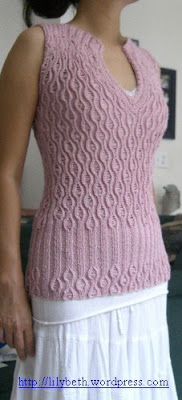 And then there is Stefanie Japel's Drop-stitch Lace Tank (the one in this picture knit by
 Norah Gaughan's Pink Vintage Cardigan, which would be equally pretty in pale yellow.
 Carrie Bostick Hoge's Little Smocked Cardigan, which is another instance of my cropped-cardigan craving. I can just imagine wearing it over a sundress.
 Melissa Wehrle's Wallis Cardigan, which I very much want to knit this summer, but which may do better in a drapier yarn, such as the original cotton/silk blend that was used in the photo version.
 Pam Allen's Flutter Sleeve Cardigan, which was originally knit in a light, drapey bamboo/soy blend yarn.
 Another design by Stefan Japel, the Puff-Sleeved Feminine Cardigan (also from her book
  An ultra-simple wrap cardigan by Debbie Bliss, but I don't have any wrap cardigans.


