Showing posts with label Tea. Show all posts

Saturday, September 22, 2007

Rooibos Pretoria

This is another sample tea from the mountain of samples I bought recently from Upton Tea Imports. After a long night at the restaurant, and an even longer week, I really wanted some tea, but I didn't want to be kept up from the caffeine. That's where rooibos comes to the rescue.

It isn't really a tea, since it isn't made from the tea plant, Camellia sinensis. Instead, it is made from the South African red bush plant, and is naturally high in antioxidants, low in tannins, and caffeine free.

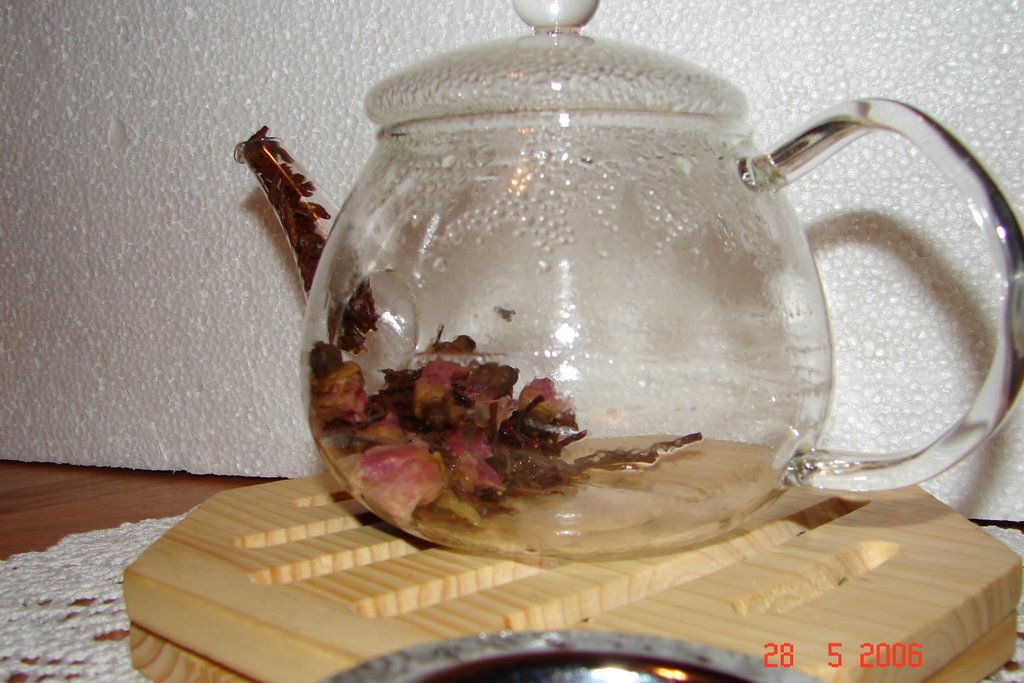
This blend, according to Upton Tea's description, contains "hibiscus, rose petals, blue mallow blossoms and sunflower petals." You can see some of the flower petals in the picture above. Isn't it pretty?

Rooibos isn't known as red bush tea for nothing. It tends to produce a warm, red liquor, and this one was a bright, golden mahogany. The dry tea smelt citrusy and peppery, but the tea itself had scents of vanilla (rooibos always seems to taste slightly sweet and vanilla-like) and the barest hint of rose. It was also warm, smooth and round, and incredibly comforting. I think this is a perfect herbal tisane for fall and winter enjoyment.

Monday, September 17, 2007

Showy Teas

I couldn't resist trying this tea out tonight, especially since I'll be up a while doing some grading. This is one of the teas I ordered a sampling of from Upton Tea Imports: Special China Green Peony Rosettes. I've always been curious about these "display" teas. They may be interesting to look at (some of them even have a red or pink flower in the middle, though not this one), but are they any good?

These teas are tied into a bunch - and sometimes subsequently rolled/folded into a ball - by hand. They are normally good for multiple infusions (a good tea for an all-nighter, perhaps?). Prior to brewing, the leaves had a deep, almost grape-like fragrance.

The rosette takes a little while to bloom. Upton Teas recommends steeping for 3 - 7 minutes. I may have over-steeped just a bit, because the tea developed a little bit of bitterness, but there wasn't any unpleasant aftertaste. The liquor had a deep, muted vegetal taste that reminded me of fall. It was also surprisingly smoky, which wasn't what I was expecting, but then I looked back at the catalogue description: "...Sweet aroma, with a delicate, smoky nuance." It was a fun experience, and I think I'll give other display teas a try, but I don't think this particular one is to my taste.

I may have overdone it...

I've been receiving quarterly catalogues from Upton Tea Imports for almost a year now, but hadn't ordered anything from them. Last week, though, I finally went through and selected some teas that I wanted to try out, and proceeded to order some samples. What do you think, did I overdo it? Their descriptions sounded so interesting, I just couldn't resist.

I have Darjeelings, Assams and Ceylons from India (I do love Indian teas!); Pu-er, lotus and peony teas from China; and rooibos and honeybush from Africa. I have two kinds of Earl Grey, one whose bergamot scent is supposed to be less overpowering, and one with blue flowers mixed in. I have tea flowers from Camelia sinensis, the tea plant. Each sample pack is labelled with the packing date, the type of tea, ideal brewing temperatures and times, and my name, and will make around 6 cups of tea. That's over 120 cups of tea, which I will surely enjoy all the more since it has started becoming rather chilly here!
I even indulged (all right, indulged myself even more) by buying this clever tea thermometer, which is colour-coded so one can easily tell when the water is at the appropriate temperature for green, oolong or black tea. Won't you come an join me for a tea party?

Wednesday, March 21, 2007

In Pursuit of Tea - First Flush

Back around Christmas, Moocow gave me some Gyokuro (a type of Japanese green tea) and first flush Darjeeling from In Pursuit of Tea as a present. I had never tried their teas before, but I love Darjeeling. The Gyokuro was lovely; green, grassy and sweet, with a rounded finish. I didn't open the Darjeeling until Moocow and my parents came to visit, two weeks ago. I have to say, Moocow and I were very disappointed. It is hard to describe Darjeeling to someone who hasn't had it before. At least, it is difficult for me, one who enjoys tea but is by no means a connoisseur, and who therefore lacks all the fancy jargon.

However, Darjeeling - whether first flush (leaves picked in the early spring) or second flush (picked in early summer) - is usually very lively and distinctive, with the perfect amount of astringency and a heady, muscatel aroma. The first time I tried a good, loose leaf first flush Darjeeling, I remember thinking, "This is why they call it the champagne of teas." One could almost become intoxicated by the taste and aroma.

So, Moocow suggested I contact In Pursuit of Tea, which I did. A very nice gentleman named Sebastien returned my call after a day or two (I'd left a message) and listened to my concerns. I admitted that I hadn't opened the tea right away, and first flushes don't keep as long. But it had been sealed in its original packaging. And I had enjoyed the Gyokuro.

He said that it could be that I didn't like their particular first flush (a possibility), and said that he would send me another 1/4-pound bag of their Darjeeling Second Flush, as well as a small, sample pack of the Darjeeling First Flush, which I promised to open and drink the moment I got it.

I received the package yesterday, before I had to go to my evening class. However, I made good my promise the moment I got home. There, on the left, you see the newly arrived teas (the little, silver pouch is a new sample of the Darjeeling First Flush) and, on the right, the previously opened bag of Darjeeling First Flush. The first thing I did was to smell the teas, comparing the previous bag of first flush to the new bag. To me, the old bag smelled stronger and more astringent, although that could just be because the bag contained more tea.
Then, I compared the tea leaves. I'm fairly certain it isn't a result of the lighting, since I looked at the actual leaves, but you might notice that the newer first flush leaves look a little darker than the older ones (on the left).

Then it was on to a taste test. I didn't feel a great need to try the old batch of first flush again; it had hardly had any flavour or aroma to distinguish itself. I used filtered water, heated to just below boiling point, and steeped the tea leaves for almost 3 minutes. I love to watch the leaves unfurl!

Below, you can see the lovely, light, golden honey colour of the liquor. The tea produced was very mild. Not as flat as the older leaves, but not what I could call lively, and still without a discernible bouquet.
First flush teas are, I believe, normally more delicate in flavour and aroma than second flush. I thought, perhaps, the second flush would be an improvement on the first flush. I tried the Darjeeling Second Flush this morning. Unfortunately, I could not recommend that tea, either. I will try with both teas once more, giving them a little longer steeping time (although I don't want to oversteep) and hoping for a slightly better taste.

At the moment, though, I can only recommend In Pursuit of Tea for their Gyokuro and their customer service. They may have other nice teas, too, but I fear that their Darjeelings are not for me.

Sunday, June 11, 2006

Housewarming - A Success Story

I know, I know. What an arrogant post title! But really, I think I deserve it. And I was so relieved when everything went fairly smoothly.

So, what goes into planning and hosting a housewarming teaparty for ten people? Well, as you know, I started pondering and trying to set the menu about 2 weeks beforehand. I agonized over whether or not I had enough teacups - even mismatched ones - when it seemed as though it was going to be a party for sixteen.

Then, the weekend and Monday and Tuesday before, I tested out some recipes. I tried a honey castella cake recipe taken from a Japanese book but, due to lack of an accurate scale (all Japanese recipes list ingredients mainly in grams) and electric mixer, it didn't turn out well. I also tried out the scone recipe from The Bread Bible, sans currants, which I did end up using.

I had work every day, of course, but here's what I did from Wednesday evening to Saturday, when the actual housewarming was.

Wednesday: Stop by Walmart to pick up last of household items. Plan out quantities of ingredients, baking, cooking and cleaning schedule. Erin lends us her electric mixer, thank God!!!

Thursday: Drop by the supermarket to pick up stuff for baking. Bake pumpkin bread. Kitchen cleanup. Cook and eat dinner. Make lunch for next day. Kitchen cleanup. Bake lavender cookies. Vacuum the apartment. Tidy up my room and living room. Kitchen cleanup. See a pattern here?
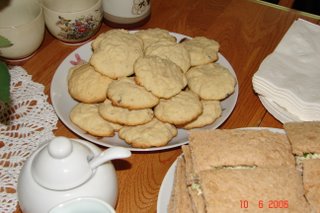

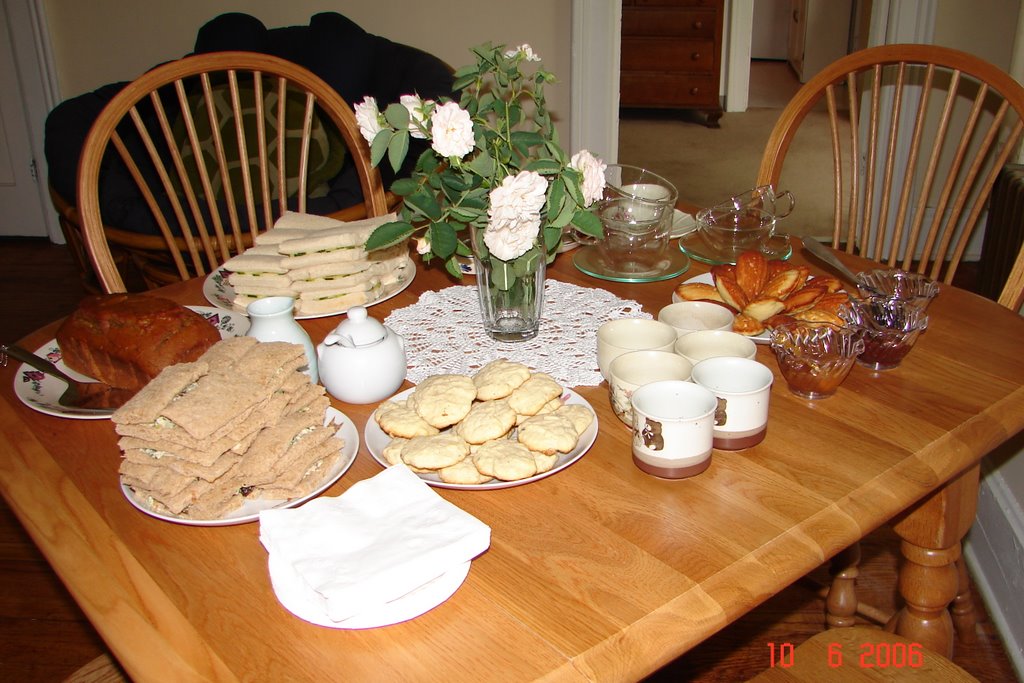
Lavender cookies and Tarragon Chicken Salad sandwiches.


Friday: Pick up hardware for Andrea to hang pictures. Drop by the supermarket to pick up salad ingredients. Bake madeleines. Kitchen cleanup. Help Andrea decide where to hang her pictures, and hang them. Make and eat dinner. Cook lunch for next day. Kitchen cleanup. Make batter for crumpets and allow to rise twice. Meanwhile, start making tarragon chicken salad. Clean and tidy pantry, closet and laundry room. Do laundry and bedding. Cook crumpets - crumpets are more difficult than they look. (Another post devoted to that in coming days, so stay tuned to learn all I learnt about crumpets!) Finish making tarragon chicken salad. Kitchen cleanup. Scrub down bathroom, except for floors.

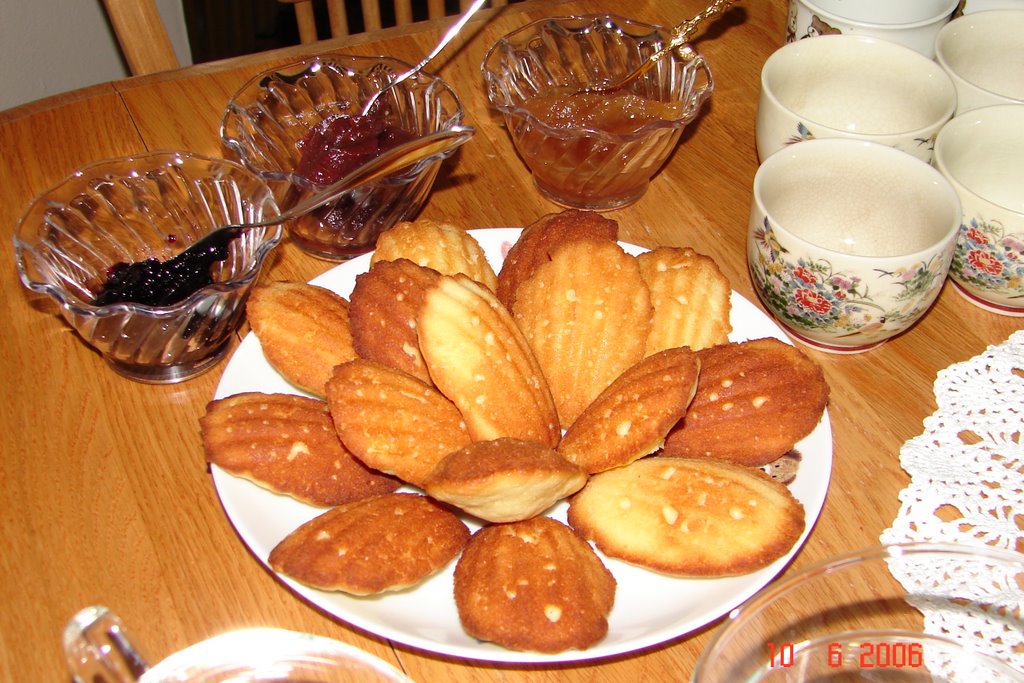
From left to right: blueberry preserves, apple butter, pear preserves. Madeleines.


Saturday: Last-minute tidying up. Take out garbage. Andrea vacuums kitchen. Clean all windows. Vacuum and mop living room, dining room, my bathroom and laundry room. Prune and water plants. Bake scones. Scrub and clean kitchen counters and cooking range. Mop living room again because landlady stopped by with baby, who threw up. Andrea mops kitchen, cuts crusts off sandwich bread. Slice cucumbers really thinly. Last minute tidy ups.

Forty-minutes until guests arrive: Put food out onto plates. Set table. Andrea puts sandwiches together. Preheat oven to toast crumpets. Run down to garden to cut some roses for the table.
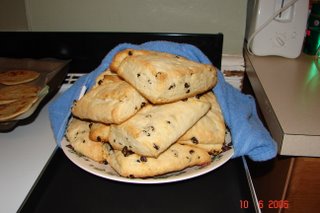
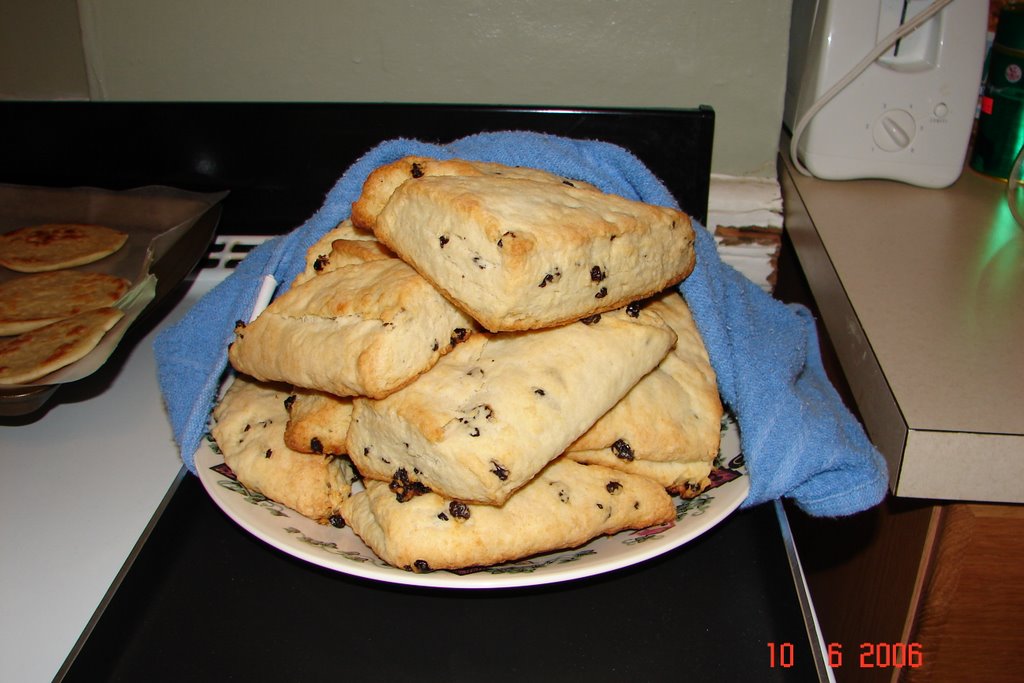
Flaky scones. I forgot to take pictures of the finished crumpets, but there they are on the left.

Guests arrive: I've always heard that it's considered polite to arrive slightly late, never early, to your host/hostess' place, because they probably have last-minute preparations to make, and you don't want to catch them when they're still running around like headless chickens. Our guests arrived ten, twenty, thirty, and eighty minutes late. A nightmare. In fact, pretty rude considering one of them was watching the World Cup, and another was at a dog show. If I was going to arrive eighty minutes late to a small gathering where everyone would be waiting for me before food or water could pass their lips, I would have made my excuses and not have come. But that's just me.
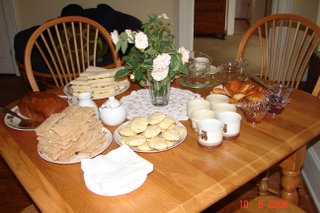
Apart from that, and the fact that the water couldn't boil quickly enough to suit me, everything went pretty well once everyone had arrived. Conversation and tea flowed more or less non-stop. People mingled and met, and the air was heady with the perfume of butter and roses. People mingled and met, and there was more than enough to eat (something I worried abuot when I thought we were having fifteen or sixteen people coming). In fact, as one guest put it, we were eating for two hours! People even took food home in doggie bags and asked for recipes, which I will take as a compliment.

It was crazy, it was hectic. But it was a job well done. I got to try lots of new recipes, and miraculously they all turned out well; even the crumpets, which - at around 11:30 p.m. on Friday night - I had considered not serving. It's served the purpose of forcing Andrea and me to finish the last of our unpacking, and we're now officially settled in. Yes, I can heave a great sigh of relief and satisfaction, and sleep most of the day away on Sunday, which I did.

--
Posted by Lana to Bumbling Bees - Food at 6/11/2006 03:06:00 PM

Sunday, May 28, 2006

Assam Rose Tea

A lot of the time, Andrea and I have some tea and maybe a little dessert together in the evenings, and tonight was one such evening (no desserts, unfortunately).

I used to see big barrels of these small, dried rose buds in apothecary shops in Hong Kong, and packaged in Chinese supermarkets, but I'd never had rose tea before. I don't know anyone else who has.

When I went back to NYC for Mother's Day I decided to take the plunge. I've been learning more about tea in the past couple of years, and I felt it was time for me to approach this unknown. Funnily enough, a lady who spoke Mandarin stopped me in the little grocery where I bought it; she asked me how to drink rose tea!

The blind leading the blind, surely. But I told her that you would usually blend it with some tea leaves, and brew as usual (suitably vague, I thought). I added that she should probably rinse the rose buds before brewing. (I have little faith in the cleanliness of Chinese processing plants.)

Moocow went to TeaSpot in NYC and bought me half-ounce samples of four different teas: two darjeelings, a ceylon and an assam. I absolutely adore darjeeling (definitely the champagne of teas), and I love good ceylons and assams, too. But somehow I felt that TeaSpot's assam wasn't as aromatic and flavourful as I'm used to.

So tonight, when it came time to choose a tea to blend the rose with, I decided to use the assam. The dried buds, when I opened the sealed pack, gave off quite a heady rose fragrance. I didn't want it to compete with - and perhaps obliterate - the muscatel notes in darjeeling, and I wasn't sure if a green tea was up to the task of supporting such robust aroma. I felt the assam was non-descript enough, but strong enough, for the task.

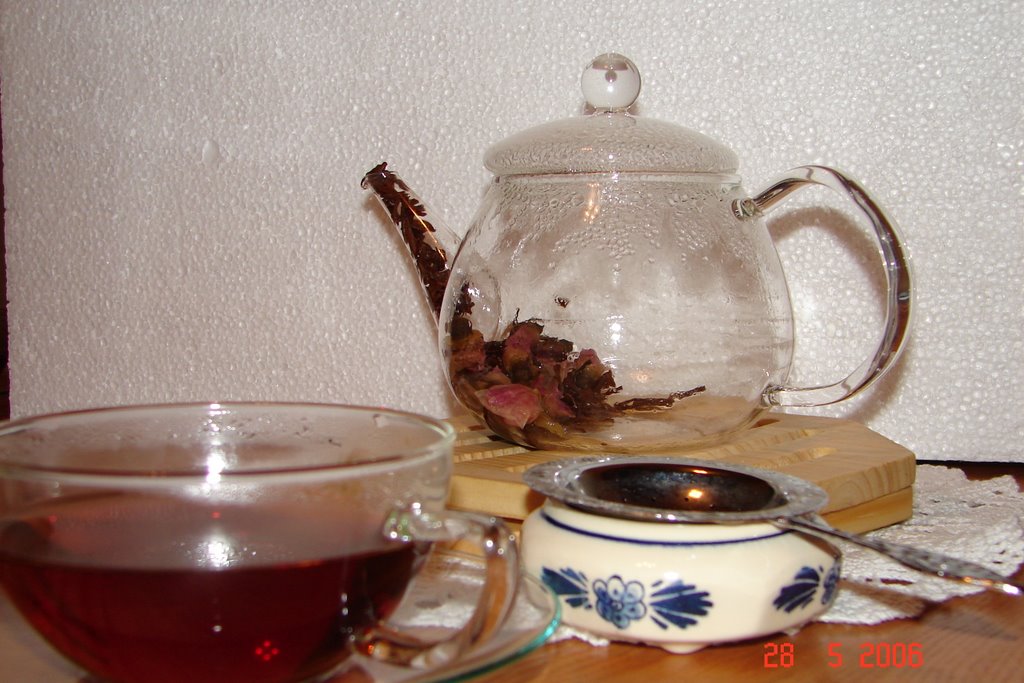
I put the rose buds and assam into my lovely glass teapot so I could watch as it steeped. It's a good thing I decided against rinsing with hot water, because the colour left the rose buds pretty rapidly. It definitely developed a darker colour, with brandy-red highlights, than the assam alone would have. Andrea commented that even the leaves left in the pot are pretty.

What struck us first was the fragrance, recognisably rose-like, so delicious it had almost a honey/liqueur-like smell. Taste-wise, Andrea and I both felt that it didn't significantly add to or take away from the flavour of the assam as we were drinking. But, sipping it slowly, I think it did add a little more complexity to the otherwise bland assam. Andrea felt that the rose flavour came through in the aftertaste. I'm not sure if that was a good thing, in her mind.

I found the aftertaste a little musky, slightly acrid. I may have oversteeped while I was looking at the pretty colours, but I don't think so. I also poured Andrea's cup first and, even though I tried to distribute the weaker tea (at the top) and the stronger tea (at the bottom) between our teacups as you would pour tea Asian-style, I think I ended up with more of the stronger tea.

Next time, I think I'll try it with a Chinese green tea and watch the steeping time more carefully. The assam rose tea definitely made me feel extra special, and I hope Andrea felt the same too (Andrea's been having grief with her grant proposal). It was lovely, if only I could do something about that aftertaste. More experimentation ahead, but I would definitely recommend rose tea. Some time, when I can grow my own roses, I'll try using fresh petals or buds!

--
Posted by Lana to Bumbling Bees - Food at 5/28/2006 09:38:00 PM